 Hardware Ready Ready to Bench?
military helicopter decline. Drones are changing the rules of the battlefield and, by observing recent conflicts – particularly that in Ukraine – concrete doubts about the future of military helicopters are beginning to emerge. These aircraft, protagonists of many past wars, are now at the center of a reflection that would have seemed almost out of place just a few years ago.
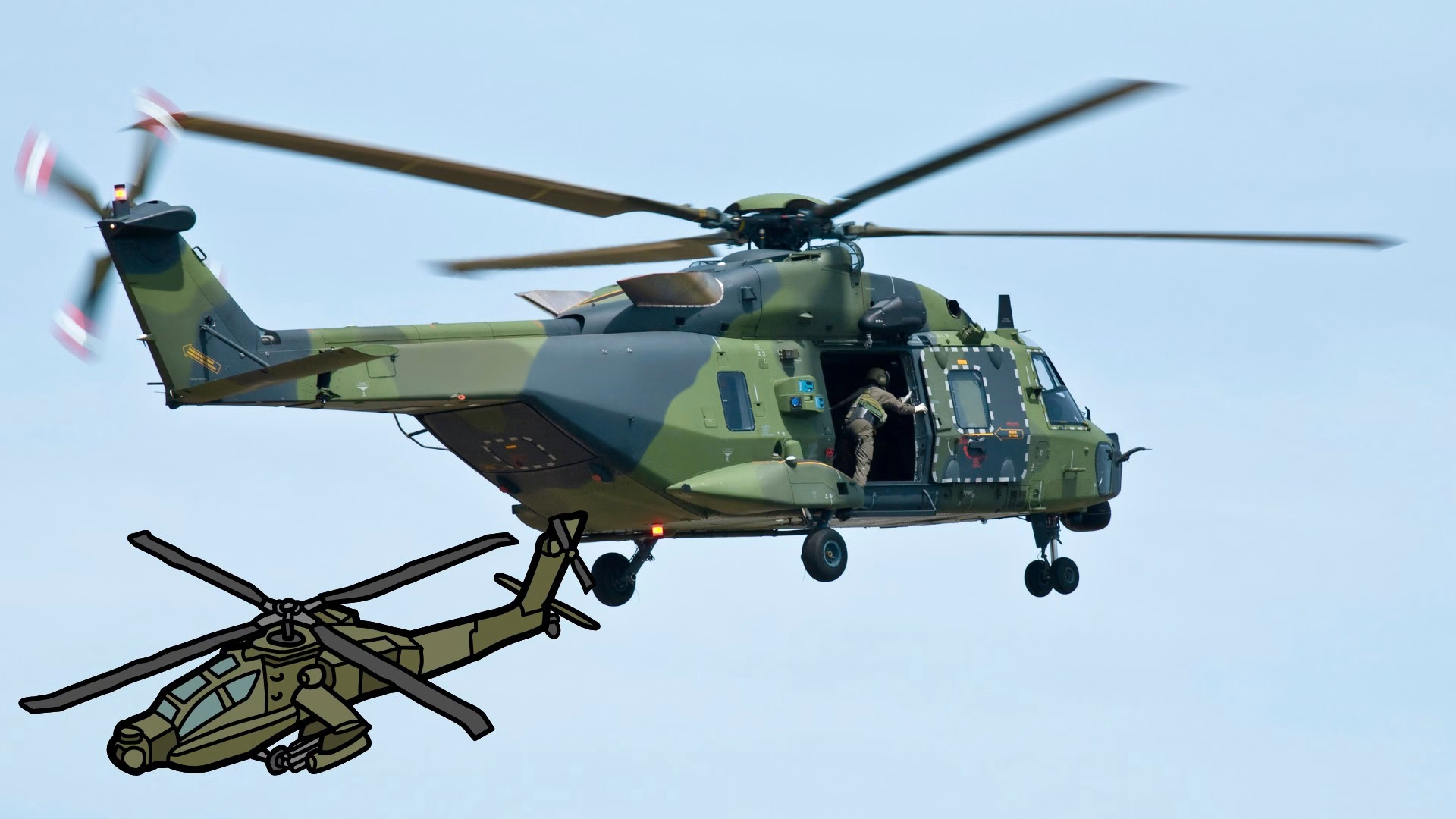
The central theme concerns the relationship between a powerful, expensive aircraft and a small, cheap, and increasingly widespread threat. Experiences accumulated in previous conflicts demonstrate this: helicopters are capable of transporting soldiers, covering considerable distances, and concentrating significant firepower at a single point. These qualities have made them valuable for decades and still weigh heavily on the decisions of those planning operations today.
military helicopter decline: why it matters
However, these same characteristics also turn them into very costly targets, whose loss has a significant impact both economically and in human terms. The Ukrainian conflict has made this vulnerability particularly evident. Small drones are indeed able to identify enemy aircraft and, in some circumstances, even attack them directly.
A small device can therefore put a much larger and more complex vehicle at a disadvantage, partially reversing the traditional logic that saw the helicopter distinguish itself from above. This is not a secondary detail, as it changes how crews and commands must assess the risks of every mission.
One might therefore ask whether military helicopters are truly on their last days. Most likely, everything depends on the type of mission at hand. There are tasks where the presence of a crewed aircraft retains precise meaning, and others where the unmanned alternative becomes decidedly more convenient, especially when the priority is not to risk human lives.
The comparison therefore does not play out on a general plane but case by case, evaluating the objectives, risks, and costs of each operation. The area where the advantage of drones appears clearest is reconnaissance, that is, the collection of information about terrain and enemy positions. Sending a drone forward allows observing the zone without exposing any crew, which alone explains why more and more operations of this type are entrusted to unmanned vehicles.
What Changes and What Are the Effects
The conditions imposed by the conflict have also contributed to modifying flying methods, pushing toward more agile and less exposed solutions. FPV models play a leading role; they are piloted by watching images transmitted in real time from the onboard camera. Those who control them see practically what the drone sees, allowing them to maneuver it with great precision even in tight spaces or complicated situations. This is an approach very different from that of traditional aircraft, which require a crew on board and therefore direct exposure to danger.
There is also a technical aspect to consider: some of these devices receive commands through a thin optical fiber instead of via classic radio waves. This choice makes them less vulnerable to signal jammers, the tools used to interfere with communications and send enemy drones out of control.
Source and further reading on military helicopter decline: original article.
* Content created with the assistance of artificial intelligence systems.