 Hardware Ready Ready to Bench?
GTA 6 PC. Progress continues to emerge regarding the development of a PC version of Grand Theft Auto VI. An independent developer demonstrated running the game at a resolution of 5120×1440 pixels, achieving a base framerate of 30 FPS and peaks up to 180 FPS thanks to the use of NVIDIA Frame Generation technology.
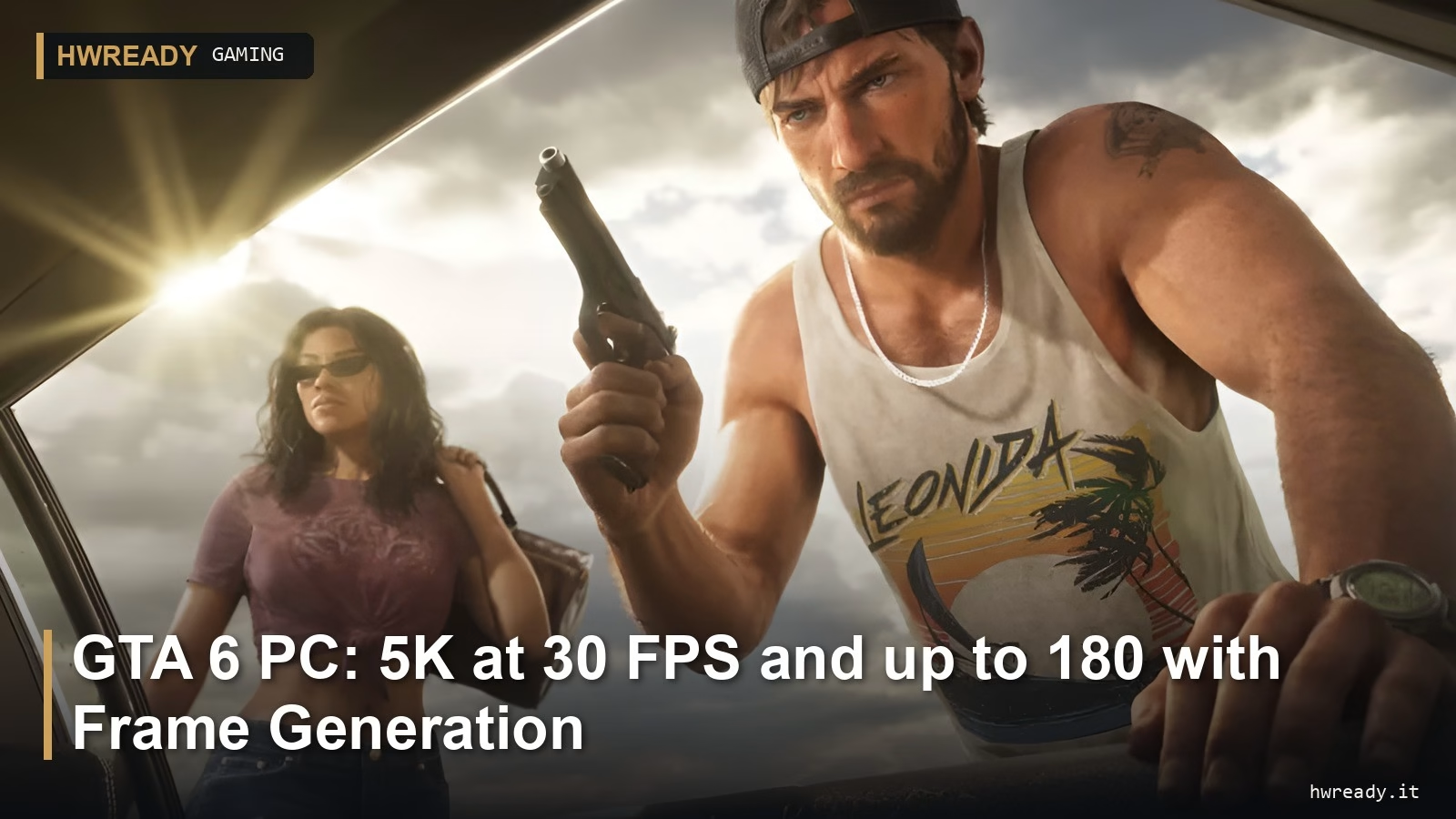
This project does not limit itself to simply running on PC; it implements specific graphical technologies for this platform that are currently unavailable on consoles. These include support for super ultrawide monitors with a 32:9 aspect ratio, as well as HDR10+, NVIDIA Reflex, and Frame Generation.
GTA 6 PC: why it matters
The developer, D Everett Hinton, shared a video of about four minutes showing the latest progress on his unofficial version of GTA 6 for PC. According to his statement, support was added for a resolution of 5120×1440 pixels, allowing the use of 32:9 super ultrawide monitors without the limitations of the traditional 16:9 format found on consoles.
In terms of performance, the developer assures that he has achieved a base of 30 FPS in 16:9 format and up to 180 FPS by leveraging Frame Generation. This means multiplying the displayed frame rate on screen by six. Although this does not imply the same latency or responsiveness as running the game natively at 180 FPS, the developer highlights that any performance issues can be compensated for by AI-assisted frame generation.
Hinton states that he has completely rewritten the CPU and GPU processing pipeline. Regarding stuttering issues related to shader compilation, these are cached after the first run of the game, thus avoiding the need to recompile them in subsequent sessions.
What changes and what are the effects
The next step involves implementing even more advanced NVIDIA technologies, such as NVIDIA DLSS 5 Neural Rendering and Ray Reconstruction. In addition to performance, the developer is working to implement further NVIDIA technologies, including DLSS Ray Reconstruction, DLSS 5 Neural Rendering, and Ray Tracing via CUDA, with the goal of improving the game’s visual quality and reducing the load on the GPU.
Other developers have already demonstrated how to apply DLSS 5 Neural Rendering and Frame Generation to GTA 6, but they did so using PS5 Remote Play. The main difference is that, in this specific case, these technologies are applied directly to the game’s rendering pipeline, offering potential improvements in both graphical quality and performance.
* Content created with the assistance of artificial intelligence systems.