 Hardware Ready Ready to Bench?
reed waste material. A team from Doshisha University in Japan has developed a material derived from reed waste capable of retaining various dyes present in water. The study, published in the Journal of Environmental Chemical Engineering, describes an active carbon enriched with copper and tested in the laboratory on three different dyes.
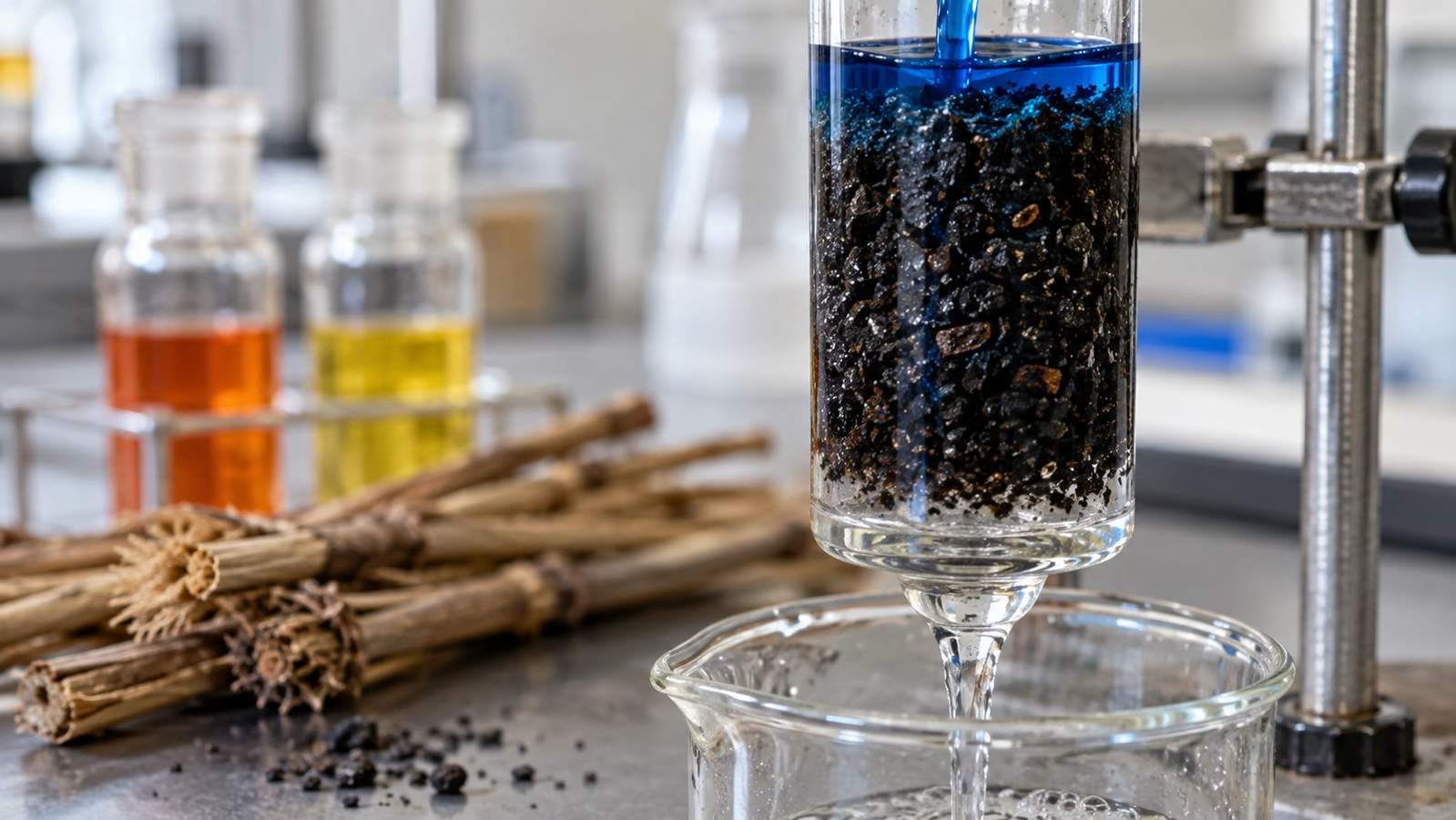
The ability to intercept molecules with different electrical charges could be useful in the purification of industrial effluents. The process starts from reed biomass, transformed via pyrolysis: the material is heated in the absence of oxygen until it forms a porous carbon structure.
reed waste material: why it matters
Copper nitrate and potassium hydroxide were added during this step. The gases produced by the biomass during heating contributed to the conversion of the copper precursor into metal particles, without the addition of further reducing agents.
The resulting product, named ZVCu@BAC, contains metallic copper nanoparticles distributed within the active carbon matrix. Analyses reveal a mesoporous structure, characterized by cavities that offer molecules access routes to the material’s surface.
The measured specific surface area reaches 984.5 square meters per gram, while the total pore volume is equal to 0.615 cubic centimeters per gram. The transformation of a waste plant into a reusable material could reduce purification costs, provided that the performance observed in the laboratory is confirmed on real industrial effluents.
To evaluate removal capacity, the group conducted adsorption tests in solution with methylene blue, methyl orange, and sunset yellow. The first is a cationic dye (positive charge), while the other two are anionic (negative charge). The material retained all three dyes during testing, as reported by the authors.
What Changes and What Are the Effects
The interaction may be due to several mechanisms. According to the researchers’ analysis, electrostatic attraction, pore filling, and bonds between dye molecules and metallic copper come into play. Comparison with unmodified reed carbon allowed evaluating the contribution of copper particles, which are distributed without forming aggregates in the matrix.
Regeneration is a crucial aspect for possible practical use. After six washing cycles with a solution of potassium hydroxide and acetone, the composite retained a removal efficiency of 90.6% for methylene blue and 88.0% for methyl orange.
The authors also estimate a production cost of approximately 1,800 yen per kilogram for the studied process.
Source and further reading on reed waste material: original article.
* Content created with the assistance of artificial intelligence systems.