 Hardware Ready Ready to Bench?
AI compromise ECDSA signatures. A respected researcher from the Ethereum Foundation has urged cryptocurrency holders to prepare for a possible risk scenario regarding their funds. Justin Drake argues that rapid advances in generative artificial intelligence in mathematics could weaken digital signatures on blockchain wallets within months.
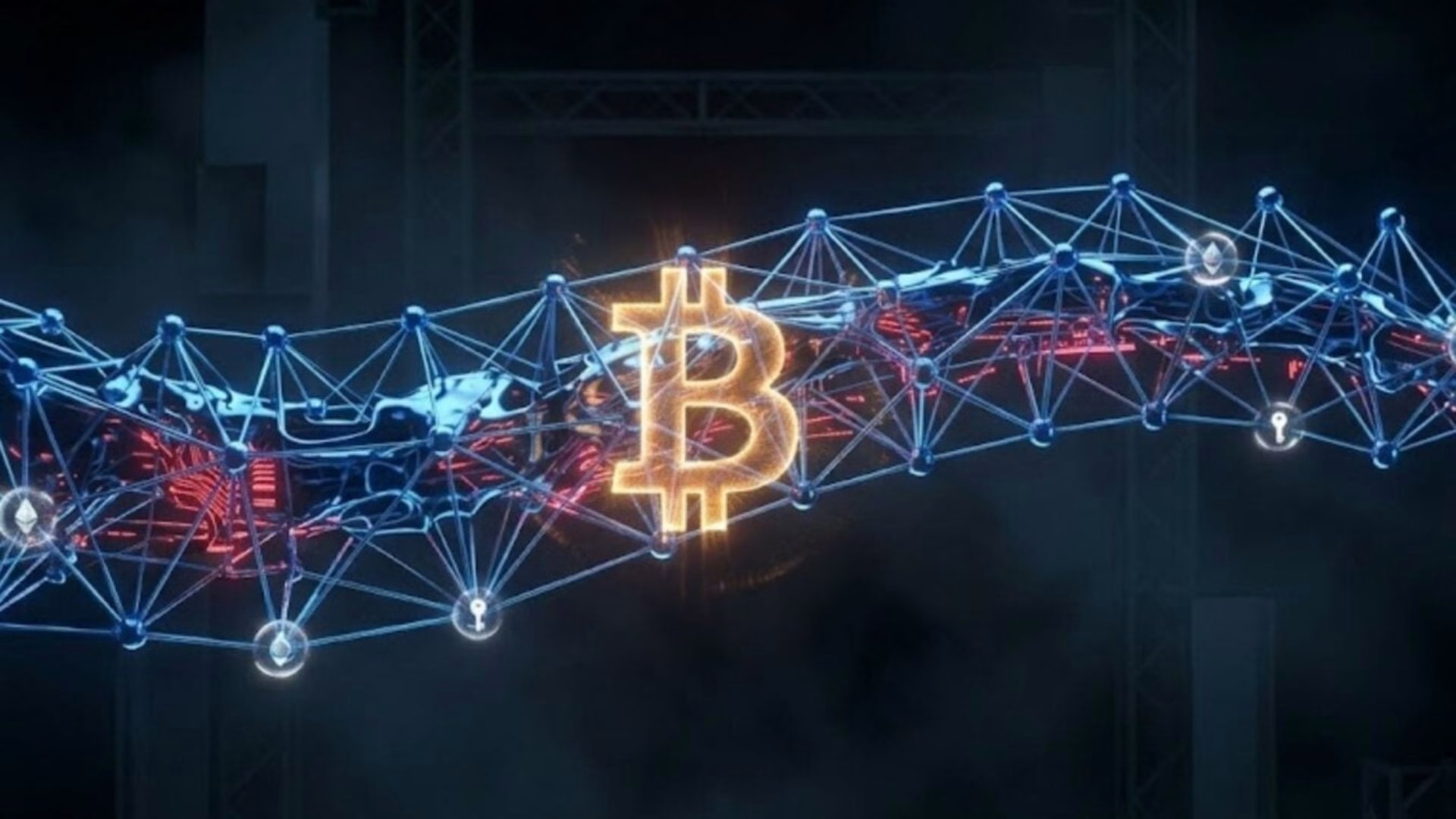
Drake raised the alarm on October 7, 2026, via a post on X, asking the blockchain industry to begin planning a defensive strategy. His main thesis is that AI might succeed in breaking the cryptography underlying Bitcoin, Ethereum, and other cryptocurrencies long before the arrival of quantum computers, traditionally considered the most serious threat.
AI compromise ECDSA signatures: why it matters
Drake highlighted how mathematical hypotheses considered solid for decades, such as the n log(n) bound for integer multiplication and the 3SUM conjecture, have recently been challenged. This would demonstrate AI’s ability to rapidly surpass the limits of traditional mathematics.
Ethereum: why the ECDSA algorithm raises concerns
The primary concern is linked to ECDSA (Elliptic Curve Digital Signature Algorithm), the elliptic curve-based signature algorithm that protects both the Bitcoin and Ethereum networks. ECDSA allows transactions to be authenticated without exposing users’ private keys.
The mechanism relies on the ease of deriving a public key from a private one, and the extreme difficulty of the reverse process. This ensures that the public key can be freely shared without risk. However, Drake hypothesizes that AI could invert this process in a short time.
Drake believes it is reasonable to prepare for the possibility that ECDSA will be compromised before so-called “Q Day,” the moment when quantum computers become powerful enough to break current cryptography. In the worst-case scenario, he speaks of weeks or a few months to recover a private key using already available hardware, such as a cluster of graphics cards.
Moving funds to new addresses, with caution
The practical advice provided by Drake is to transfer most funds to new addresses that have never signed transactions. This way, the public key remains hidden behind a hash, making it more difficult for an attacker to trace back to the private key even if the algorithm is compromised.
Holders of large amounts of cryptocurrency should be the first to act. Subsequently, the remaining funds should be moved to another address, which can also be generated from the same wallet recovery phrase. However, Drake insists on the importance of avoiding impulsive actions and hasty migrations that could cause more harm than good.
He also invited major platforms like Binance, Robinhood, Bitfinex, and Tether to strengthen their offline storage systems. Those holding small amounts are unlikely to be primary targets, enjoying partial protection thanks to the “Satoshi shield,” consisting of approximately 20,000 exposed addresses belonging to Satoshi Nakamoto that each contain 50 BTC.
Reactions and the alarm triggered by OpenAI
Vitalik Buterin, co-founder of Ethereum, also expressed a cautious opinion, advising against panicking. In his view, it is easier to lose funds due to rushed and misconfigured updates than due to cyberattacks.
Drake’s alarm did not come as a surprise. On October 6, OpenAI published 722 mathematical manuscripts generated by an internal model, some of which overturned hypotheses established for decades. The previous month, ChatGPT had solved an equation that had remained open for 200 years.
During the summer, Anthropic demonstrated that Claude Mythos Preview was able to identify a flaw in the HAWK algorithm, designed for post-quantum security, in just 60 hours. These events suggest that AI is rapidly acquiring advanced mathematical capabilities.
However, not all experts share Drake’s concerns. Charles Guillemet, CTO of Ledger, acknowledges AI progress as surprising but considers it premature to claim that blockchain security is at risk in the near future.
Source and further reading on AI compromise ECDSA signatures: original article.
* Content created with the assistance of artificial intelligence systems.