 Hardware Ready Ready to Bench?
reduce fusion energy needs. Physicists at the Princeton Plasma Physics Laboratory (PPPL), a laboratory dependent on the US Department of Energy, have identified a possible theoretical path to reduce the energy required to trigger nuclear fusion: heating the fuel before increasing its density.
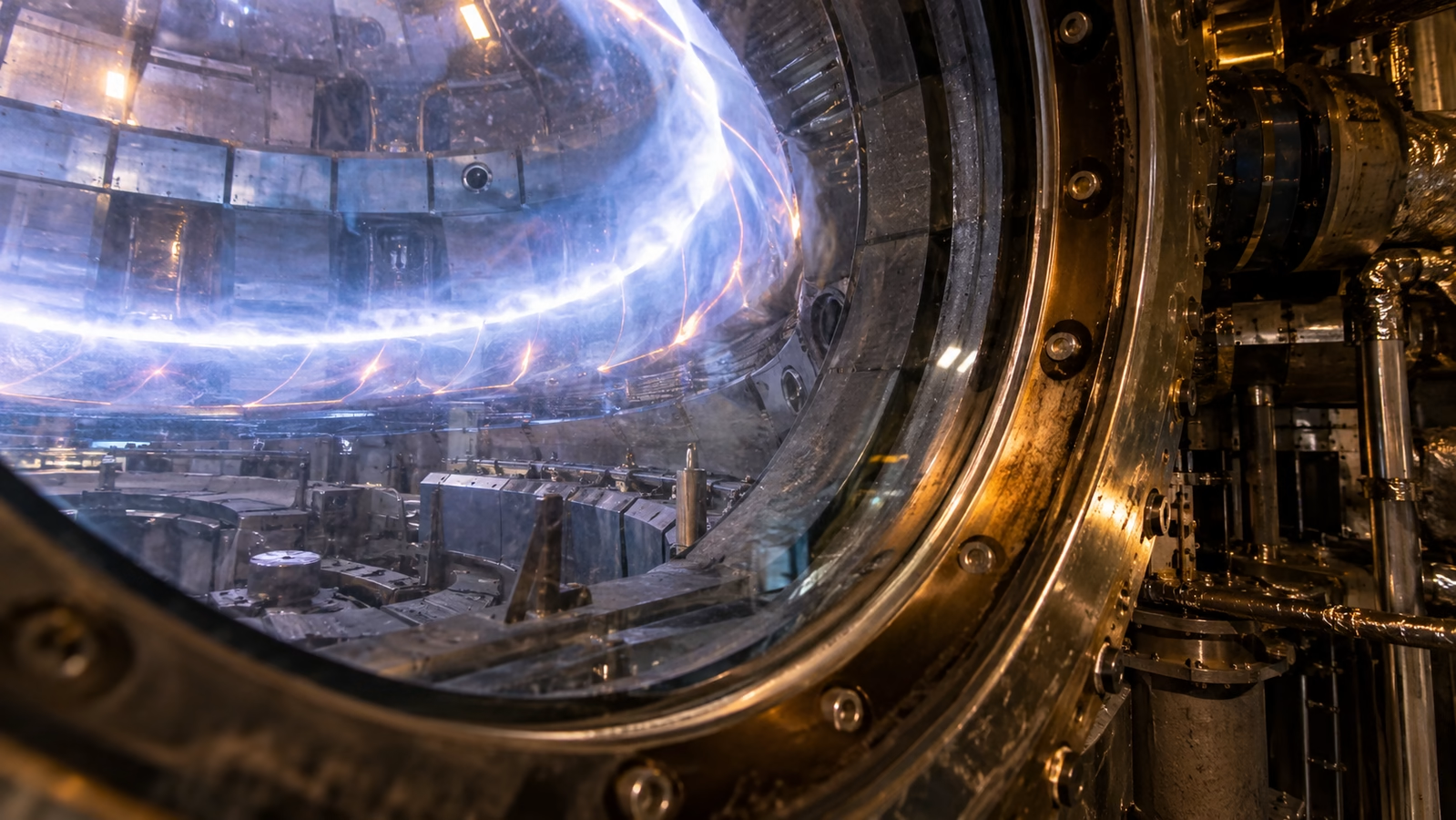
The research, published in Physical Review Letters, suggests modifying the sequence used to reach the conditions necessary for reactions to produce enough heat to self-sustain without external heating. Luis Delgado-Aparicio, Masayuki Ono, and Jonathan Menard developed a more complete version of the Lawson criterion, the relationship used for over seventy years to evaluate the conditions required for self-sustained fusion.
reduce fusion energy needs: why it matters
The criterion relates temperature, density, and energy confinement time but does not specify which path requires less energy to reach ignition. The fuel exists in the plasma state, an ionized gas containing electrically charged particles. According to the researchers’ calculations, increasing the density first and then providing the necessary heat can result in a high energy demand.
Inverting the order by initially heating the plasma and subsequently making it denser would instead allow reaching the desired conditions following a less costly path. The energy required to start fusion could therefore depend on the order in which the plasma is heated and compressed.
The model reveals an element called the Cordey saddle, located along the boundary between conditions that still require external heating and those compatible with self-sustained reactions. Delgado-Aparicio describes the situation by comparing it to a mountainous landscape: instead of facing the highest peak, the proposed path uses a lower pass to reach the same goal.
To compare different approaches, the group uses the Q factor, which is the ratio between the power produced by fusion reactions and that supplied to the plasma via external heating. A value of Q = 5 indicates that the former is five times higher than the latter. In the idealized case of pure fuel, the Cordey saddle is located approximately at this value; impurities and intense magnetic fields can shift it toward higher Q values.
What Changes and What Are the Effects
The new formulation incorporates four additional factors that influence performance and considers jointly physical processes often analyzed separately. The goal is to make the evaluation of magnetic confinement reactor designs more reliable before their construction: according to Ono, including these effects can change the judgment on the conditions necessary for ignition.
The result derives from theoretical calculations and not from a new experimental ignition. The indications are valid for both tokamaks and stellarators, the two families of devices that use powerful magnetic fields to confine hot fuel. PPPL includes this work in its research program on future fusion pilot plants: the model offers designers a tool to compare heating and compression strategies and identify potentially costly energy requirements before building the facilities.
Source and further reading on reduce fusion energy needs: original article.
* Content created with the assistance of artificial intelligence systems.