 Hardware Ready Ready to Bench?
Smart #2 testing complete. The new Smart #2 is poised to carry on the Fortwo’s legacy and will be one of the main attractions at the 2026 Paris Motor Show, taking place from October 12 to 18. The compact electric vehicle has just concluded an extensive road-testing cycle focused on verifying handling, quietness, reliability, and safety.
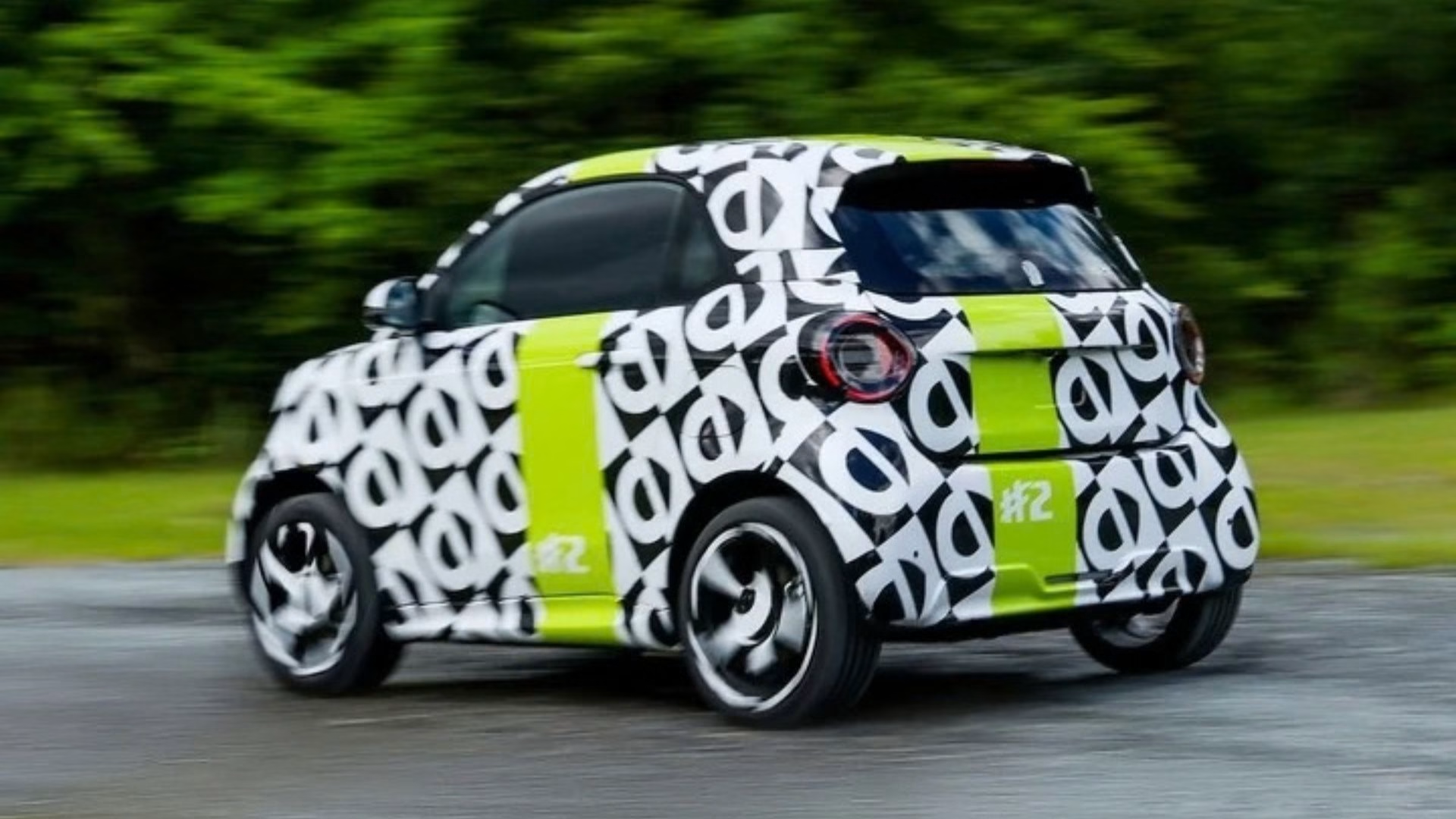
Over the years, Smart has evolved into a brand capable of operating across multiple segments, but it is important to remember that everything began with the success of the Fortwo. The prototype and pre-series validation program has made this new two-seater city car suitable for a wide range of scenarios, extending well beyond urban environments.
Smart #2 testing complete: why it matters
Engineers focused their efforts on driving stability and acoustic-vibration comfort, achieving high safety standards. The transition from concept to production vehicle was made possible through collaboration between the Mercedes-Benz Design Team and Smart’s Research and Development divisions.
This green reinterpretation of the Fortwo is generating growing international interest. The car has been spotted on public roads wearing a distinctive black-and-white camouflage livery, signed by the Mercedes-Benz Global Design Team. Its agility was put to the test through various challenging urban scenarios, including emergency lane changes and driving on wet asphalt with low grip.
Following the launch of the #1, #3, and #5 models, the manufacturer chose to look to its past, at least in terms of styling. Tuning of key chassis components, steering ratio, rack travel, and suspension control has ensured high comfort levels in one of the most compact electric cars currently on the market. The configuration with wheels positioned near the four corners of the body is also a clear homage to the past, which early owners of the original Smart will immediately recognize.
What changes and what are the effects
The primary goal is to offer an evolved and, above all, quiet in-cabin experience. To achieve this, the Smart #2 underwent a comprehensive NVH (Noise, Vibration, and Harshness) validation program dedicated to reducing noise and vibrations under various operating conditions. Tests were conducted in wind tunnels, anechoic chambers, and on four-actuator test rigs with temperature control, as well as on public roads.
To further refine sound quality, engineers experimented with different tire compounds on various asphalt types, including rough surfaces, grooved concrete, and high-speed straights. This work allowed them to maximize range even on irregular roads characterized by continuous undulations, potholes, and roughness—a common scenario in many cities.
Source and further reading on Smart #2 testing complete: original article.
* Content created with the assistance of artificial intelligence systems.