 Hardware Ready Ready to Bench?
Unemployment Labs identified numerical patterns within the public weights of the DeepSeek-V4-Flash model that suggest the use of NVIDIA Blackwell GPUs during the initialization phase. The lab was able to reconstruct an hardware fingerprint from the parameters distributed by the developers, adding new technical elements to the debate on Chinese access to accelerators subject to US export controls.
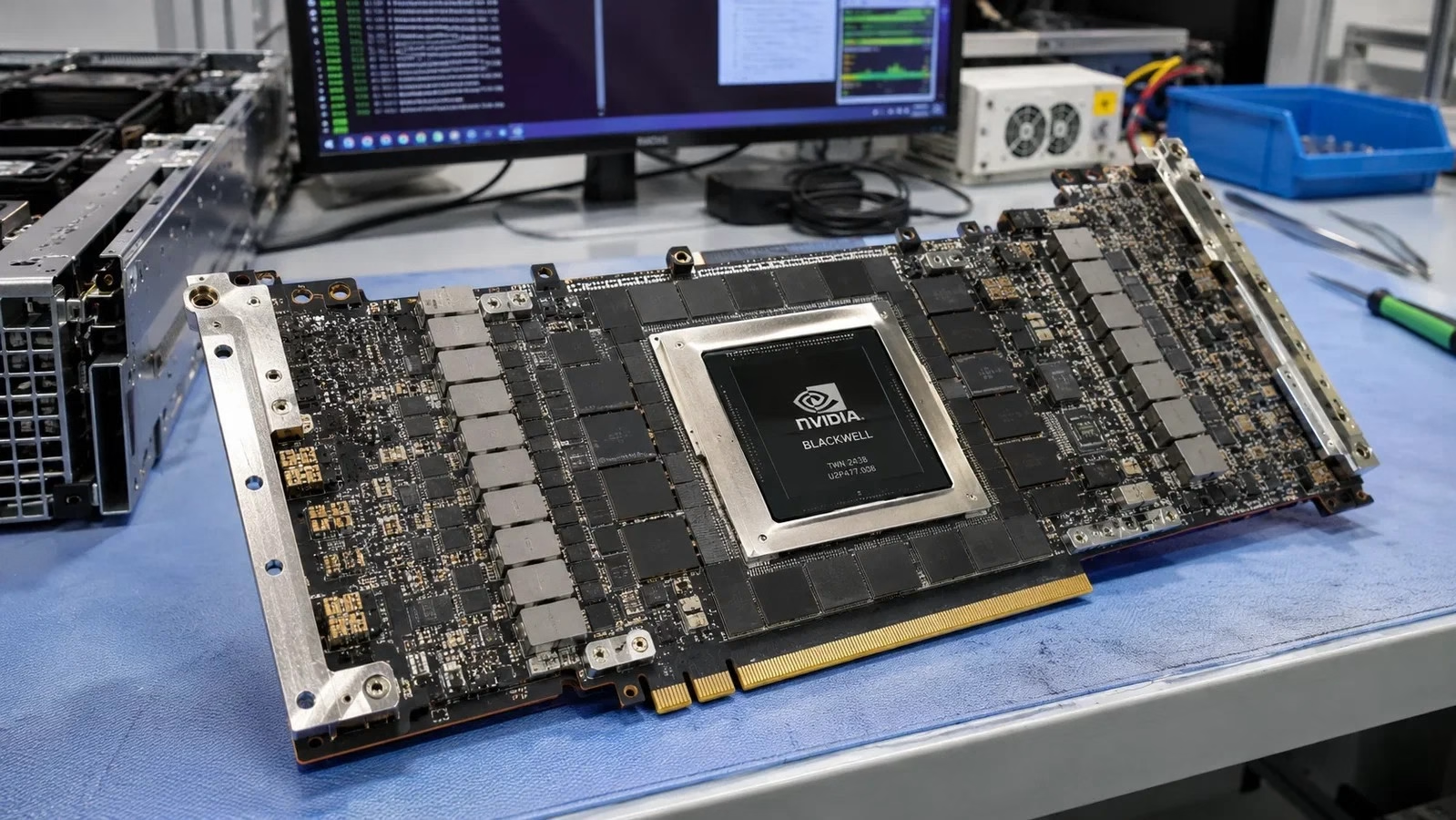
The analysis is based on the model’s weights, which are the numerical values that allow a neural network to transform an input into an output. Before training, these values are initialized using a pseudorandom number generator driven by a “seed,” a starting value. During the training phase, many parameters undergo changes, but some retain traces of the initial configuration, providing useful material for forensic analysis.
DeepSeek-V4-Flash: why it matters
The lab compared the recovered patterns with those associated with streaming multiprocessors, the computing blocks of NVIDIA accelerators. The different Hopper and Blackwell architectures produce recognizable layouts; by reconstructing the seed and processing structure, it is possible to search for a match in the published parameters. A model’s public weights can therefore retain the fingerprint of the GPUs used to initialize it, offering a new method for hardware verification.
The investigation also extends to the DeepSeek-V4-Pro, MiniMax-M3, Kimi K3, and Ling-3.1-flash models, involving companies DeepSeek, MiniMax, Moonshot AI, and Inclusion AI. The hypothesis is that several Chinese developers had access to Blackwell accelerators to prepare their respective models, with hardware fingerprints recoverable directly from the weight files.
Estimates on GPU clusters hypothesize an usage of approximately 3,000-4,500 accelerators per single training session and a cumulative range between 7,000 and 22,000 units for the models considered. This calculation depends on session duration, utilization efficiency, and possible infrastructure sharing; the higher value assumes that the different models were trained on separate clusters rather than using the same systems at different times.
What changes and what are the effects
It is important to note that the identified fingerprint concerns the hardware used for initialization and does not prove that the same GPUs executed the entire training process, nor where they were installed, how access was obtained, or whether export controls were violated. Among the possible modes of access, remote use of clusters has been hypothesized, making computing capacity available through infrastructure physically located outside China.
The comparison yielded different results with DeepSeek-V4.1-Flash: the lab reports not having found a similar fingerprint in the new architecture. Several Alibaba Qwen3 models also present a different situation, as their weights were initialized on a standard processor (CPU), leaving a trace different from the GPU procedure examined in the investigation.
Source and further reading on DeepSeek-V4-Flash: original article.
* Content created with the assistance of artificial intelligence systems.