 Hardware Ready Ready to Bench?
An experiment conducted by der8auer allowed us to observe the evolution of liquid metal used for cooling CPUs and GPUs over time, highlighting that it does not merely degrade but chemically reacts with the metals of the surfaces on which it is applied.
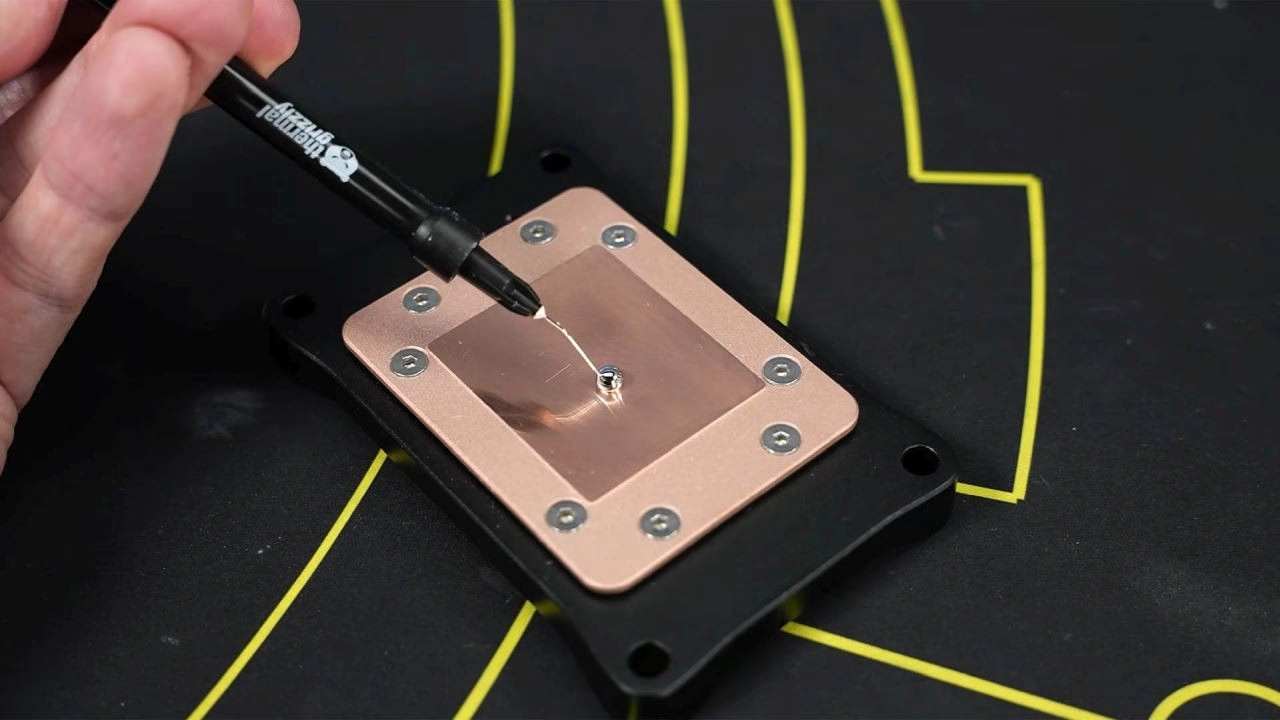
Gallium can weaken aluminum and form solid compounds with copper. Nickel plating, on the other hand, significantly limits this reaction. Liquid metal is an increasingly common solution for improving heat dissipation from processors and graphics cards, especially in components characterized by high thermal density.
liquid metal: why it matters
The analysis, which lasted two years and was conducted by Roman Hartung – founder of Thermal Grizzly, better known online as der8auer – allowed us to observe under an electron microscope what happens to this material over time. The results highlight an important aspect: liquid metal does not merely lose its initial characteristics but reacts with the metals it comes into contact with, forming new solid compounds.
The experiment concerns a gallium-indium based alloy, possibly enriched with tin, such as Conductonaut commercialized by Thermal Grizzly. These alloys can remain liquid at room temperature: the mixture of gallium, indium, and tin used in this type of application melts around 11 °C, while pure gallium melts at approximately 30 °C.
The properties of these materials allow reducing the thermal resistance of the interface between the component and the cooling system, but their behavior also depends on the type of surface on which they are applied.
The most problematic behavior occurs in contact with aluminum. When gallium manages to overcome the superficial oxide layer, it penetrates along the grain boundaries of the metal, weakening its structure. In the test conducted by der8auer, a 2 mm thick aluminum sheet began to swell after about five minutes and became brittle within half an hour. This phenomenon makes aluminum unsuitable for direct contact with gallium-based liquid metal.
With copper, the process is different. Gallium reacts with the surface forming the intermetallic compound CuGa₂, consisting of one copper atom for every two gallium atoms. The indium and tin present in the alloy contribute to forming additional solid zones. The surface progressively takes on a crystalline appearance and the material becomes difficult to remove even with isopropyl alcohol or acetone.
The main problem concerns the thermal properties of the compound that forms. CuGa₂ has a thermal conductivity of approximately 100 W/mK, compared to about 400 W/mK for copper. The new layer therefore conducts heat much less effectively than the original metal.
The compound also remains solid up to approximately 254 °C, making it impossible to return it to a liquid state with simple heating at normal PC operating temperatures. Observations over time show that liquid metal is still visible in its liquid state one hour after application; after two months the surface presents crystals and no longer shows visible liquid metal. Two years from the start of the test, the situation remains substantially unchanged compared to what was observed in the second month.
Partial protection comes from nickel-plated copper heatsinks, a solution widespread in PC cooling systems. In this case, gallium predominantly forms NiGa₂, a compound that is also solid at room temperature. The nickel coating significantly reduces the amount of material absorbed by the surface and limits the growth of the reaction layer. Measurements indicate a thickness on the order of a few micrometers, about ten times lower than that observed on uncoated copper.
What changes and what are the effects
NiGa₂ nevertheless has a thermal conductivity lower than that of copper-gallium. The advantage of nickel consists mainly in limiting gallium penetration and protecting the underlying copper, not in completely eliminating chemical reactions. For this reason, Hartung generally considers a nickel-plated surface preferable to bare copper when using liquid metal.
Liquid metal retains an important advantage: it can offer thermal performance superior to that of many traditional pastes, a characteristic that makes it interesting for demanding processors and GPUs. The increase in power dissipated per unit area has made reducing the thermal resistance between the chip and the heatsink increasingly important.
According to Hartung, NVIDIA RTX 5080 and RTX 5090 GPUs have a power density approximately three and two times higher than that of a GeForce 8800 GTX, respectively. The downside is represented by application complexity and the electrical conductivity of the alloy: a leak can cause short circuits, while an incorrect choice of materials can damage metal surfaces. Removing residues can also be laborious.
Hartung therefore believes that this technology should remain intended primarily for enthusiasts and expert users, for example those practicing heavy overclocking on components with high thermal density. The cost of raw material has also become a factor to consider: Hartung reported that the price of gallium paid by his company went from about 300 euros per kilogram to 2,500-3,000 euros over five years, with further increases recorded since 2025. China represents approximately 99% of global supply, an element that exposes the market to trade restrictions and geopolitical dynamics.
Thermal Grizzly is evaluating new alternative coatings to nickel, with the aim of introducing them in the future, and a new version of the KryoSheet graphene pad for chips without metal coverage. The latter solution could offer slightly lower performance, in the order of 3-4 °C compared to liquid metal according to reported estimates, but with greater ease of use.
Source and further reading on liquid metal: original article.
* Content created with the assistance of artificial intelligence systems.