 Hardware Ready Ready to Bench?
The Mac mini M5 Pro positions itself as the most reasonable option for a new purchase, with a premium of approximately 100 euros compared to the M4 Pro model. It offers more CPU cores, higher memory bandwidth, and updated connections. The compact form factor and main ports remain unchanged.
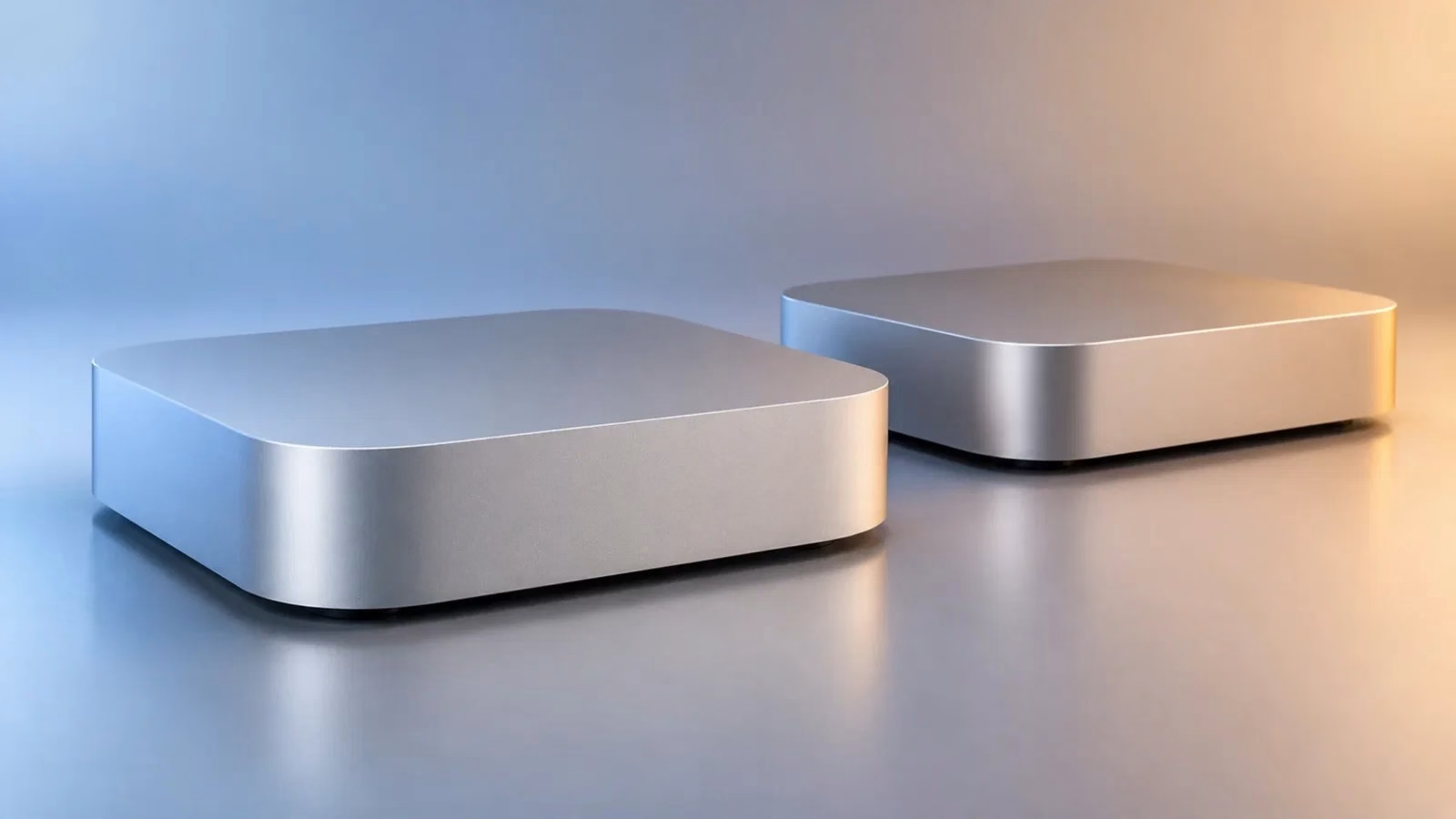
The comparison between the Mac mini M5 Pro and Mac mini M4 Pro begins by analyzing entry-level configurations: the M5 Pro moves from 12 to 15 CPU cores, meaning three additional cores. The increase is 25%, but this percentage does not automatically translate into a performance boost; both the architecture and CPU composition change as well. The Mac mini M4 Pro combines eight performance cores and four efficiency cores, while the M5 Pro model employs five super cores and ten performance cores.
Mac mini M5 Pro: why it matters
Below is a summary table of key specifications:
| Base CPU | Mac mini M4 Pro | Mac mini M5 Pro |
| 12 cores | 15 cores | |
| Memory bandwidth | 273 GB/s | 307 GB/s |
| Unified memory | 24 GB; 48 and 64 GB options | 24 GB; 48 and 64 GB options |
| Base SSD | 512 GB | 512 GB |
Memory bandwidth increases by 34 GB/s, roughly a 12.5% improvement. It is important to note that the increased bandwidth does not resolve the limitations imposed by the 24 GB available in the base model; for projects exceeding this capacity, switching to the same amount of memory on the new generation does not eliminate the restriction.
Both models occupy 12.7 × 12.7 cm on the desk, with a height of 5 cm. On the rear are three Thunderbolt 5 ports and HDMI, while the front features two USB-C ports up to 10 Gb/s. An external SSD or dock already connected to the Mac mini M4 Pro will therefore find the same types of connections on the successor: changing computers does not add new ports to the workstation.
The entry-level configurations also retain 24 GB of memory and a 512 GB SSD, with options for 48 and 64 GB of memory and storage up to 8 TB. Those seeking more space for video libraries or virtual machines must compare these tiers, because the switch from M4 Pro to M5 Pro alone does not increase available capacity.
The base GPU counts 16 cores on both models, and both accelerate H.264, HEVC, ProRes, and ProRes RAW via hardware, in addition to decoding AV1. For editing footage in these formats, the Mac mini M4 Pro already has dedicated functions: the new chip does not introduce this compatibility from scratch. However, the identical number of graphics cores does not measure architectural differences.
How do performance and connections change? Apple claims language model processing up to four times faster and ray tracing up to 1.4 times quicker compared to the Mac mini M4 Pro. These are maximum declared values for specific workloads, not results automatically applicable to every program or both base configurations. The ray tracing data, for example, does not imply a 40% improvement in every game or across an entire video edit. The practical distinction is where the work is executed: if the language model runs on the Mac, local acceleration can reduce wait times; if you use a chatbot processed on remote servers, that comparison does not describe service speed.
Similarly, the ray tracing advantage benefits those who employ that technique in their software. With standard 2.5Gb Ethernet, nominal wired network speed rises compared to 1 Gb/s: an advantage usable with compatible NAS and switches. With a Gigabit switch, the connection remains limited to 1 Gb/s. Both generations also feature optional 10 Gb Ethernet: those owning an M4 Pro with this configuration do not get faster wired networking by buying the new base model.
What changes and what are the effects
Wi-Fi 7 replaces Wi-Fi 6E, and Bluetooth moves from version 5.3 to 6. Leveraging new features requires compatible devices: a Bluetooth keyboard already at home does not gain new capabilities by changing Macs. For wireless connectivity, the router matters as much as the computer’s specifications.
What do the Mac mini M5 Pro and Mac mini M4 Pro cost in Italy? As of November 1, 2026, the Mac mini M5 Pro has been on sale since September 22 starting at approximately 2,030 euros; the reference price for the Mac mini M4 Pro is about 1,930 euros. The gap is just around 5% when comparing versions with 24 GB of memory and a 512 GB SSD. This is a homogeneous comparison on capacity, not between an upgraded old model and a basic new one.
Mac mini M5 Pro. For those buying their first professional Mac mini, we choose M5 Pro if the comparison remains between 24 GB and 512 GB at approximately 2,030 versus 1,930 euros. The modest premium justifies the updated platform, especially with local models, compatible rendering, or a 2.5Gb NAS already in use. The Mac mini M4 Pro becomes preferable when savings significantly exceed the indicated 100 euros, or when a configuration with more memory fits the budget while the new equivalent exceeds it.
For those owning a Mac mini M4 Pro, we recommend keeping the previous model if work proceeds without problematic waits, memory is sufficient, and monitors, docks, and network are already adequate. Switching from an M4 Pro with 48 GB to an M5 Pro with 24 GB would be a wrong choice for projects requiring that capacity. Upgrading makes sense when local model processing or ray tracing are frequent activities slowing down work; outside these conditions, you pay for an update while maintaining the same form factor, main ports, and base capacity.
Source and further reading on Mac mini M5 Pro: original article.
* Content created with the assistance of artificial intelligence systems.